
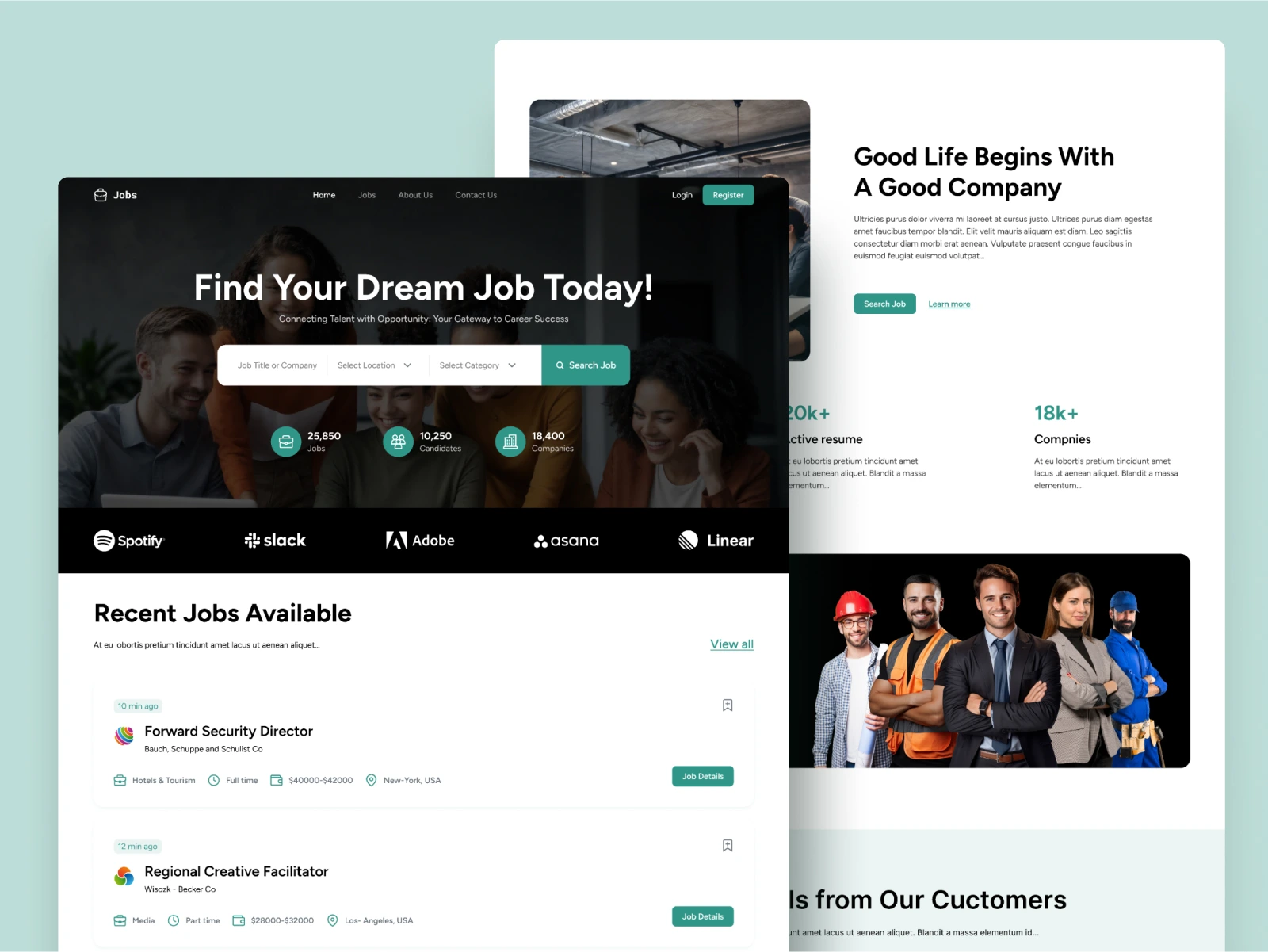
Job Portal Website Development in Nepal: Cost, Features, Technology and Complete Development Guide
The way people search for jobs and businesses recruit employees has changed significantly. Job seekers no longer depend entirely on newspaper advertisements, physical applications, or personal connections to discover employment opportunities. Employers are also moving away from completely manual recruitment processes and increasingly using digital platforms to find, evaluate, and communicate with candidates.
This shift has created significant opportunities for job portal website development in Nepal.
A job portal is an online platform that connects employers with job seekers. Employers can publish vacancies, receive applications, review candidates, and manage recruitment activities, while job seekers can create profiles, upload resumes, search for opportunities, apply for positions, and track their applications.
However, a professional job portal is much more than a website containing job listings. A modern platform needs separate experiences for candidates, employers, recruiters, and administrators. It may also require resume management, advanced search, job recommendations, application tracking, employer verification, subscription plans, payment integration, notifications, analytics, and communication tools.
For businesses planning to build a recruitment platform in Nepal, understanding the technical requirements, business model, development cost, and long-term scalability is essential.
This guide explains job portal website development in Nepal in detail, including important features, development process, technology choices, SEO requirements, security, estimated cost, monetization models, and how to build a platform that can serve both employers and job seekers effectively.
What Is a Job Portal Website?
A job portal website is a digital platform where employers and job seekers interact through an online recruitment system.
Employers use the platform to publish vacancies and find suitable candidates. Job seekers use it to search for jobs and submit applications.
A basic job portal may simply display vacancies and allow candidates to apply.
A more advanced platform can manage the entire recruitment lifecycle, from creating a vacancy to hiring a candidate.
For example, an employer could create a company profile, publish a job vacancy, receive applications, filter candidates based on qualifications, shortlist suitable applicants, schedule interviews, communicate with candidates, and update the recruitment status.
Candidates can create profiles, upload resumes, search for jobs, save interesting vacancies, apply online, and monitor the progress of their applications.
The administrator manages the overall platform, including employers, candidates, job listings, payments, reports, content, verification, and moderation.
This three-sided structure makes a job portal significantly more complex than a standard corporate website.
Why Build a Job Portal in Nepal?
Nepal has a large and diverse workforce, with people searching for opportunities across technology, hospitality, finance, education, healthcare, construction, tourism, retail, manufacturing, and many other sectors.
At the same time, companies need efficient ways to find qualified employees.
A dedicated job portal can bring these two groups together through a centralized digital platform.
Traditional recruitment methods can require employers to publish vacancies across multiple channels and manually organize applications. A job portal can consolidate these activities into one system.
For candidates, a portal can make job discovery easier by allowing them to search according to location, industry, experience, salary, employment type, and other criteria.
For employers, it can reduce recruitment administration and provide structured candidate information.
For the platform owner, a job portal can create revenue through employer subscriptions, featured vacancies, recruitment services, advertising, resume access, or other business models.
Job Portal vs Recruitment Website
A recruitment website usually represents one company or recruitment agency.
It may publish vacancies belonging to that organization and allow candidates to submit applications.
A job portal serves multiple employers.
This distinction creates additional technical requirements.
A multi-company job portal needs employer registration, company profiles, job posting management, employer dashboards, candidate databases, application tracking, subscriptions, permissions, and administrative moderation.
If recruitment agencies are also allowed to operate on the platform, the system may require additional roles and workflows.
The architecture should therefore be designed around multiple organizations rather than a single employer.
Types of Job Portals
There are several possible models for a job portal.
A general job portal can cover many industries and employment categories.
A specialized portal can focus on one sector, such as technology, healthcare, hospitality, education, construction, or finance.
There can also be portals focused on particular geographic regions.
For example, a platform could focus specifically on employment opportunities within Nepal or target Nepali professionals seeking international opportunities.
Another model is a recruitment marketplace that connects employers with recruitment agencies or professional recruiters.
The business model should be defined before development because it affects the platform’s features and architecture.
Essential Features of a Job Portal
A professional job portal needs to provide useful tools for candidates, employers, recruiters, and administrators.
Candidate Registration and Profile
Job seekers should be able to create accounts and maintain professional profiles.
A candidate profile can contain education, experience, skills, certifications, languages, location, employment preferences, salary expectations, and other relevant information.
Candidates should also be able to upload resumes and update their information whenever necessary.
The profile should be designed to make important qualifications easy for employers to understand.
Resume Management
Resume management is an important part of a job portal.
Candidates should be able to upload resumes in supported formats and update them when required.
Depending on the platform, the system can also provide a resume builder where candidates create professional resumes using predefined templates.
A resume builder can be a useful premium feature if the business intends to monetize the platform.
The system should also protect uploaded resumes because they contain personal and professional information.
Job Search
Job search is one of the most important features of the platform.
Candidates should be able to search vacancies using keywords and relevant filters.
Depending on the portal, filters can include job category, location, employment type, experience level, salary range, education requirement, company, posting date, remote work availability, and other job-specific attributes.
The search experience should remain simple even when thousands of vacancies are available.
For a large platform, search technology may eventually require dedicated indexing rather than relying entirely on basic database queries.
Job Categories
Jobs should be organized into logical categories.
Examples can include software development, marketing, accounting, education, hospitality, engineering, healthcare, sales, administration, design, and other professional areas.
Categories help candidates discover relevant opportunities and also create useful landing pages for SEO.
The category structure should be carefully planned because changing it later can affect URLs, search results, and existing job data.
Job Details Page
Every vacancy should have a dedicated page containing the information candidates need to decide whether to apply.
A professional job page can include the position title, company, location, employment type, salary information where available, experience requirements, responsibilities, qualifications, skills, benefits, application deadline, and application instructions.
The page should also clearly communicate whether the vacancy is active.
Expired vacancies should be handled appropriately so candidates do not waste time applying to positions that are no longer available.
Employer Registration and Company Profiles
Employers need a dedicated registration process.
A company profile can contain its name, logo, description, industry, location, website, contact information, and other relevant details.
Verified employer profiles can increase trust among candidates.
Depending on the business model, employers may need to submit company documentation before they can publish jobs.
The administrator can review the information and approve or reject the employer account.
This verification process can help reduce fake companies and fraudulent vacancies.
Employer Dashboard
Employers need a dashboard where they can manage their recruitment activities.
The dashboard can allow companies to create vacancies, edit job posts, view applications, shortlist candidates, communicate with applicants, schedule interviews, and monitor recruitment progress.
Employers should also be able to see their active and expired vacancies.
A good dashboard should make frequent actions easy.
Recruiters should not have to navigate through multiple unnecessary pages simply to review applications or update a vacancy.
Job Posting System
The job posting system should allow employers to create structured vacancies.
A vacancy may include the position title, department, location, job type, experience level, education requirements, salary range, skills, responsibilities, qualifications, benefits, application deadline, and other information.
The system can also provide templates for frequently used job types.
Before publication, vacancies can be reviewed automatically or manually by administrators.
Moderation is particularly important for a public job portal because fraudulent, misleading, or inappropriate job advertisements can damage the platform’s reputation.
Online Job Application
Candidates should be able to apply directly through the platform.
An application can use the candidate’s existing profile information and resume, reducing repetitive data entry.
The system should record the application date and current status.
A typical application workflow could move through stages such as submitted, reviewed, shortlisted, interview, selected, or rejected.
The exact stages should be configurable according to the portal’s requirements.
Applicant Tracking System
An Applicant Tracking System, commonly called ATS, allows employers to organize and manage candidates.
An employer can review applications, filter candidates, add notes, change statuses, shortlist applicants, and communicate with selected candidates.
An ATS becomes especially valuable when a company receives hundreds of applications for a single vacancy.
Instead of manually maintaining candidate information in spreadsheets, recruiters can manage the recruitment pipeline directly within the platform.
Candidate Filtering and Screening
Employers often need to find candidates who meet specific requirements.
The platform can provide filters based on experience, education, skills, location, salary expectations, and other profile information.
More advanced platforms can support resume parsing or automated matching.
However, automated candidate ranking should be implemented carefully.
Recruitment decisions can affect people’s employment opportunities, so businesses should avoid blindly relying on automated scoring systems.
Human review should remain an important part of recruitment workflows.
Employer-Candidate Communication
A job portal can include communication features that allow employers and candidates to interact.
Depending on the platform, communication may happen through internal messaging, email, notifications, or interview scheduling tools.
Keeping important communication connected to the relevant application can make recruitment easier to manage.
For privacy and security, access to messages and candidate information should be restricted according to user permissions.
Interview Scheduling
Interview scheduling can be integrated directly into the job portal.
Employers can propose interview dates and candidates can receive notifications.
The system can record the interview status and relevant notes.
For advanced platforms, calendar integrations and online meeting services can also be connected.
This reduces the need for recruiters to manage interview scheduling through separate tools.
Job Alerts
Candidates may not want to check the portal every day.
Job alerts can notify users when new vacancies match their preferences.
For example, a candidate can select a job category, preferred location, and experience level.
When a relevant vacancy is published, the system can send an email or in-platform notification.
Job alerts can increase repeat usage and help candidates discover opportunities faster.
Saved Jobs
Candidates should be able to save interesting vacancies.
A saved-job feature allows users to create a personal collection of positions they may want to apply for later.
This can be particularly useful when candidates are comparing multiple opportunities.
The platform can also use saved-job behavior to improve recommendations.
Job Recommendations
A more advanced job portal can recommend vacancies based on candidate profiles and activity.
Recommendations can consider skills, experience, location, industry, job preferences, and previous interactions.
For example, a candidate with software development experience could receive recommendations for relevant developer positions.
Recommendation systems should be designed carefully because irrelevant recommendations can reduce trust in the platform.
Employer Subscriptions and Paid Job Posting
Many job portals monetize through employers rather than charging candidates.
The platform can offer different employer plans.
A basic plan may allow a limited number of job postings.
A professional plan could include more vacancies, candidate search, featured listings, analytics, and additional recruitment tools.
Large companies may receive custom enterprise packages.
Subscription management should be integrated into the employer dashboard so companies can understand their current plan, usage, renewal date, and available features.
Featured Jobs and Sponsored Listings
Featured vacancies can provide additional revenue.
Employers can pay to place their jobs in prominent positions on search results, category pages, or the homepage.
The platform should clearly distinguish sponsored placements from normal rankings where appropriate.
Featured listings can also provide employers with a way to increase visibility for urgent recruitment requirements.
Candidate Database for Employers
A premium job portal may allow employers to search the candidate database.
Instead of waiting for applications, recruiters can proactively discover potential candidates.
Search filters can include skills, experience, location, education, job category, and other information.
Access to candidate profiles should be controlled carefully.
Candidates should understand how their information can be discovered and should have appropriate privacy settings.
Notifications and Email Communication
Notifications are necessary for keeping users informed.
Candidates may receive alerts about application status, new matching jobs, interview invitations, and messages.
Employers may receive notifications about new applications, subscription events, and account approvals.
Email notifications can be useful for important events, while in-platform notifications can handle frequent updates.
Notification systems should be designed to avoid sending excessive messages.
Admin Dashboard
The administrator controls the entire job portal.
The admin panel can be used to manage employers, candidates, job listings, categories, applications, subscriptions, payments, advertisements, reports, content, complaints, and system settings.
Administrators can also review reported jobs and user accounts.
For larger platforms, different administrative roles can be created for customer support, finance, content moderation, and system management.
This allows the organization to divide responsibilities while maintaining appropriate access controls.
Job Portal SEO
SEO is one of the most important aspects of job portal development.
Unlike a private recruitment dashboard, public job listings can attract substantial search traffic.
A well-structured job portal can create dedicated landing pages for job categories, locations, industries, companies, and individual vacancies.
For example, pages targeting searches such as software developer jobs in Kathmandu or accounting jobs in Nepal can potentially attract relevant users.
Each job page should have a clear title, readable content, descriptive URL, useful metadata, and appropriate structured data where applicable.
JobPosting structured data can help search engines understand job vacancy information.
However, structured data must accurately represent the content visible on the page.
Expired jobs also need careful handling. The website should not allow outdated vacancies to remain misleadingly active.
A strong job portal SEO strategy should combine technical SEO with useful content rather than generating thousands of thin pages solely to target keywords.
Content Marketing for a Job Portal
A job portal can build organic traffic beyond individual job listings.
The platform can publish useful career content covering interviews, resumes, salary information, career development, industry trends, job-search strategies, workplace skills, and recruitment advice.
For example, articles such as “How to Write a Resume in Nepal,” “Common Interview Questions for Fresh Graduates,” or “Best IT Jobs in Nepal” can attract candidates who may eventually use the platform.
Employer-focused content can also attract businesses looking for recruitment solutions.
This creates a broader SEO ecosystem around the job portal.
Mobile-Friendly Job Portal Development
Job seekers frequently search for vacancies from smartphones.
The platform therefore needs a responsive mobile interface.
Job search, filtering, registration, profile editing, resume uploads, and applications should all work comfortably on smaller screens.
Employers may also need to review applications from mobile devices.
For a large platform, a dedicated mobile application can eventually be developed using the same backend APIs as the website.
However, a responsive website should generally provide a strong experience before investing in native applications.
Technology Stack for Job Portal Development
The technology stack should be selected according to the portal’s expected scale and functionality.
A modern job portal can use Next.js or React for the frontend.
Backend systems can be built using technologies such as Django, Laravel, Node.js, Go, or other suitable frameworks.
PostgreSQL or MySQL can handle structured data such as users, employers, vacancies, applications, subscriptions, and payments.
Cloud storage can be used for resumes and company documents.
Search infrastructure may become important when the platform contains a large number of vacancies and candidate profiles.
Caching, background processing, CDN services, and monitoring can also improve performance as the platform grows.
The best technology is therefore the one that fits the project’s requirements rather than the one that happens to be most popular.
Job Portal Security and Privacy
Job portals handle sensitive personal information.
Candidate profiles can contain phone numbers, email addresses, education details, employment history, resumes, and other professional information.
Employers may also provide company information and recruitment data.
Security should therefore be included throughout the development process.
The platform should implement secure authentication, role-based authorization, HTTPS, protected APIs, input validation, secure file handling, database security, backups, monitoring, and appropriate access controls.
Resume files should not be publicly accessible through predictable URLs unless the candidate has explicitly chosen to make them public.
The system should also prevent unauthorized users from accessing employer or candidate information.
Privacy policies and data handling procedures should be established according to the business’s target markets and applicable legal requirements.
Job Portal Monetization Models
A job portal can generate revenue through several models.
Employer-paid job postings are one of the most straightforward options.
Companies pay to publish vacancies on the platform.
Another option is employer subscriptions, where companies receive a monthly or annual package containing a certain number of job postings and recruitment features.
Featured jobs can generate additional revenue by giving employers greater visibility.
Candidate resume services can also become a revenue stream. For example, the platform could offer professional resume creation, career consultations, or premium profile features.
Advertising is another possibility, although advertisements should not significantly reduce the user experience.
Large job portals can combine several monetization models rather than relying on one source of income.
Job Portal Development Cost in Nepal
The cost of developing a job portal in Nepal depends on the size and complexity of the platform.
A simple job board with employer registration, job posting, candidate registration, search, and basic administration requires considerably less development than a complete recruitment marketplace with ATS functionality, subscriptions, candidate search, messaging, AI-based matching, payments, analytics, and mobile applications.
A general planning range can be considered as follows:
| Job Portal Type | Approximate Cost in Nepal |
|---|---|
| Basic Job Portal | NPR 30,000 – 75,000 |
| Professional Job Portal | NPR 75,000 – 1,25,000 |
| Advanced Recruitment Platform | NPR 1,25,000 – 1,75,000+ |
| Enterprise Job Marketplace | NPR 1,75,000 – 2,00,000+ |
These are approximate development ranges rather than fixed market prices.
The final quotation depends on the number of user roles, employer features, candidate functionality, payment systems, subscriptions, ATS functionality, search capabilities, integrations, UI/UX complexity, security requirements, hosting infrastructure, and ongoing maintenance.
A detailed requirements document should be prepared before comparing development quotations.
Factors That Affect Job Portal Development Cost
The number of user types can significantly affect development requirements.
A simple platform with candidates, employers, and administrators is relatively straightforward.
A larger recruitment marketplace may also include recruitment agencies, recruiters, moderators, finance staff, advertisers, and corporate administrators.
Advanced search is another factor.
Searching thousands of job listings requires more sophisticated architecture than searching a small collection of vacancies.
Integrations can also increase development requirements. Payment gateways, email services, SMS providers, calendar systems, video meeting platforms, resume parsing tools, and external recruitment services all require API development and testing.
Mobile applications, AI features, analytics, automated matching, and enterprise-level security can further increase the budget.
How Long Does It Take to Build a Job Portal?
Development time depends on scope.
A basic job board can potentially be completed within several weeks to a few months.
A professional job portal with employer dashboards, candidate profiles, applications, payments, subscriptions, notifications, search, and administrative controls may take several months.
A large recruitment marketplace with advanced candidate search, ATS functionality, multiple integrations, AI-based recommendations, mobile applications, and scalable infrastructure can require considerably more time.
The development process should be divided into clear milestones.
An MVP approach can be useful for startups because it allows the platform to launch with core functionality and expand after receiving feedback from real employers and candidates.
Building an MVP Job Portal
A startup does not necessarily need every recruitment feature from the beginning.
An MVP could focus on the essential relationship between employers and candidates.
The initial platform could provide employer registration, candidate accounts, job posting, job search, applications, basic dashboards, and administration.
Once the platform attracts users, more advanced capabilities can be introduced.
These might include employer subscriptions, featured jobs, candidate search, resume services, messaging, interview scheduling, analytics, job recommendations, and mobile applications.
This approach can reduce initial development costs while allowing the business to validate its marketplace model.
Common Job Portal Development Mistakes
One of the most common mistakes is building a large platform before validating demand.
A job portal needs both employers and candidates. Having thousands of registered candidates without enough quality vacancies creates a poor experience. The same problem occurs when employers join but cannot find suitable candidates.
The marketplace needs to balance both sides.
Another mistake is allowing low-quality or fraudulent job listings.
Trust is essential in recruitment. Employers should be verified appropriately, and suspicious vacancies should be reviewed.
Poor search functionality is another major problem.
If candidates cannot quickly find relevant jobs, they are unlikely to return.
The platform should also avoid making the application process unnecessarily complicated.
A candidate who needs to complete a long form for every vacancy may abandon the application.
How to Choose a Job Portal Development Company in Nepal
A job portal requires more than basic website development experience.
The development company should understand user authentication, multi-role systems, search, databases, payment integration, subscriptions, file management, SEO, security, and scalable architecture.
Ask potential development partners about previous marketplace, recruitment, ecommerce, or SaaS projects.
The project agreement should clearly specify functionality, technology, source-code ownership, milestones, delivery expectations, warranty, maintenance, hosting, third-party services, and future support.
It is also important to discuss SEO before development begins.
URL structure, job page architecture, category pages, structured data, indexing rules, sitemap generation, and expired job handling should be considered as part of the platform architecture.
Future of Job Portal Development in Nepal
The future of recruitment platforms is likely to become increasingly data-driven.
Artificial intelligence can assist with resume analysis, job recommendations, candidate-job matching, interview preparation, communication assistance, and recruitment analytics.
For example, a candidate could receive job recommendations based on skills and experience rather than simply matching keywords.
Employers could receive candidate suggestions based on predefined recruitment criteria.
However, automated recruitment systems need careful design.
AI-generated recommendations should not become an unquestioned replacement for human judgment, particularly when decisions affect employment opportunities.
Transparency, privacy, fairness, and appropriate human oversight should remain important considerations.
Mobile recruitment will also continue to grow, particularly as candidates increasingly expect to search and apply for jobs from smartphones.
Final Thoughts
Job portal website development in Nepal offers a strong opportunity to build a digital platform connecting employers and job seekers in a more organized and efficient way.
A professional job portal can provide candidate profiles, resume management, job search, employer accounts, job posting, online applications, applicant tracking, interview scheduling, notifications, subscriptions, payments, analytics, and administrative management.
The complexity of the platform depends on the business model.
A simple job board can be relatively affordable, while a complete recruitment marketplace with ATS capabilities, employer subscriptions, candidate search, advanced matching, payment systems, AI functionality, and mobile applications requires significantly more investment.
The most important part of development is understanding the recruitment process before writing code.
The platform should make it easy for candidates to discover relevant opportunities and apply without unnecessary friction. Employers should be able to publish vacancies, review applicants, and manage recruitment efficiently. Administrators should have the tools necessary to maintain quality, security, and platform performance.
SEO should also be treated as a core part of the product rather than something added after development. Search-friendly job pages, category structures, useful career content, structured data, and appropriate handling of expired vacancies can help a portal build sustainable organic visibility.
Ultimately, a successful job portal is not simply a collection of job advertisements. It is a digital recruitment ecosystem that connects candidates and employers, simplifies hiring, improves job discovery, and creates measurable value for both sides of the employment marketplace. Talk to our team.